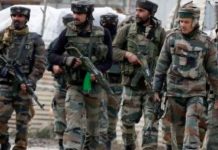
So far, the Taliban’s take over of Kabul has had no detrimental fallout on the region’s security landscape, especially in Kashmir where it was most anticipated, reports Riaz Wani
On August 15, 2021, the Taliban took over Kabul after fighting the United States to a standstill following a war of attrition that stretched over two decades. A year on, the Taliban is now firmly in control of the country, having vanquished all opposition, including in Panjshir. But so far the Taliban regime in Kabul has had no detrimental fallout on the region’s security landscape, especially in Kashmir where it was most anticipated.
As the Taliban forced the US into a chaotic, hasty withdrawal last year, India was alarmed. Top BJP leader Ram Madhav was the first to warn of “serious security challenges”. He said the end of the war would free over “30, 000 mercenaries,” in Afghanistan who would be deployed elsewhere. But the fears have not come true as there has been no expected escalation in violence in Kashmir.
The militancy in the Valley, despite occasional killings, remains at its lowest ebb in years. So much so, that at times its end seems very much at hand. True, there has been some spillover of arms from Afghanistan, confirmed early this year by none other than the then Army chief General Manoj Mukund Naravane.
In the recent past, videos showing militants carrying M249 automatic rifles, 509 tactical guns, M1911 pistols, and M4 carbine rifles have surfaced. Security forces have also recovered over a dozen Iridium satellite phones and Wifi-enabled thermal imagery devices that help militants to infiltrate and circumvent security cordons. These weapons were used by the US forces in Afghanistan. But these weapons have made no difference to the prevailing situation on the ground.
This is unlike the Taliban’s previous stint in power, which led to a steep rise in violence in the Valley. A few scores of Afghan and Afghan-trained militants scaled up the violence in Kashmir. But that there has been no turn for the worse in the violence in Kashmir this time round testifies to the fact that the world has moved on. The Taliban itself has shown some indifference to any involvement in Kashmir. It craves global legitimacy, aid and recognition, and it just doesn’t want to get associated with other battles. And this is also apparent from the balanced noises its leaders have so far made on Kashmir. Soon after taking control of Kabul last year, the Taliban made it clear that Kashmir was “an internal and bilateral issue”. Senior Taliban leader Anas Haqqani said in an interview with an Indian Television channel that Kashmir was being beyond its “jurisdiction”. Another leader of the outfit, Sher Mohammad Abbas Stanekzai said the Taliban wants economic and political ties with India.