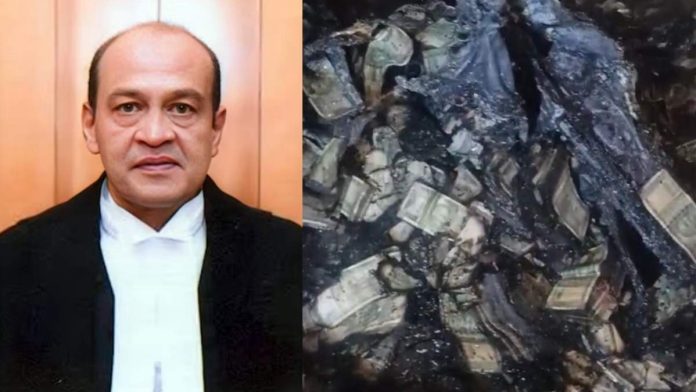
The Supreme Court’s inquiry into sacks of burnt cash found at Justice Yashwant Verma’s residence has sparked judicial turmoil. His repatriation to Allahabad High Court amid transparency concerns have intensified debates on judicial accountability. A report by Mudit Mathur
The Supreme Court of India has initiated a three-member in-house inquiry into allegations surrounding the discovery of sacks of burnt cash in a storeroom at the official residence of Justice Yashwant Verma, a senior Delhi High Court judge, after a fire broke out on March 14, 2025. This inquiry has led to his repatriation to the Allahabad High Court, sparking protests and an indefinite strike by Allahabad lawyers. Justice Verma was in Bhopal when the fire broke out, while his daughter and his elderly mother were at home. Justice Verma has denied any knowledge of the cash, suggesting it may be part of a deep conspiracy against him.
Chief Justice of India Sanjeev Khanna has taken a historic step towards transparency by releasing redacted inquiry documents, including a preliminary report submitted to him by Delhi High Court Chief Justice Devendra Upadhyay, and annexing Justice Verma’s categorical denial of any knowledge of the cash found on his premises. The uploaded material also features a brief video showing a firefighter collecting a pile of charred currency notes from the still-smouldering storeroom, along with two photographs.
These efforts reflect a shift towards openness, contrasting prior cases of judicial impropriety of sitting judges of the apex court. The controversy has raised concerns about judicial accountability and public trust in the system, while a Public Interest Litigation challenges the investigation process.
Amazingly,the shocking incident came into the public domain a week later, on March 21, 2025, which raises many unanswered questions, including the ownership and disappearance of the cash and blatant inconsistencies in the handling of evidence by the Delhi Police and Fire Services.
In this context, several questions arise from public discourse. Who brought and kept the currency notes, if any, in the storeroom, and when? Most importantly, who did they belong to? Why did the Delhi Police not register an FIR under Section 326(f) of the Bharatiya Nyaya Sanhita, which prescribes punishment for arson, to determine whether the fire was an act of arson or an accident, such as a short circuit? Why did the Delhi Police not cordon off the scene of the crime? Who removed the debris or burnt currency notes (if any) on the morning of March 15, 2025? Why were the currency notes, if any, found in the storeroom not shown to Justice Verma’s family members, as he has claimed? Where are the remains of the burnt currency notes visible in the video shared by the Commissioner of Police, Delhi, with Chief Justice Upadhyay? Were they seized? If not, why? Who saw the burnt currency notes? Have the remains been disposed of? If so, why, and by whom? Who recorded the video? Where is the CCTV footage of entry and exit to Justice Verma’s bungalow premises and storeroom? Finally, does an in-house inquiry have the authority to take evidence on oath and subject witnesses to cross-examination? If not, how will the inquiry reach a definitive conclusion?